
Foreigners can buy property in Thailand in their own name — but only certain types, and only through certain structures. A condominium unit can be owned outright (freehold); land and villas can be held only through a registered long-term lease or a company. Here is the September 2026 picture: what you can own, the transaction step by step, fees, moving money in, common mistakes and timelines.
What a foreigner can own in Thailand
Condominium units: freehold within the foreign quota
Under the Condominium Act, foreigners may own up to 49% of the residential floor area of any condominium building — the foreign quota. A unit inside that quota is registered in your name at the Land Department outright: you can sell, gift, bequeath and rent it freely.
The remaining 51% is Thai quota. A foreigner can hold a Thai-quota unit only through a leasehold or a Thai company, which is why the first thing we check on any listing is whether the building still has free foreign quota. In popular buildings it is often fully taken.
How much does this narrow the choice in practice? As of September 2026 our Pattaya catalogue lists 391 apartments for sale. In Jomtien, 83 of 151 units are listed with foreign quota; on Pratumnak 57 of 90; in Wongamat 30 of 65. The filtered selection is on our foreign quota condos in Pattaya page.
Villas, houses and land: leasehold or a Thai company
Foreigners cannot own land in Thailand. Two structures are used:
- Leasehold — a 30-year land lease registered at the Land Department, with renewals written into the contract with the landowner. Whether the house itself can be registered separately from the land depends on the property — confirm with a lawyer for the specific deal.
- Thai company — a company with a Thai majority shareholding owns the land, and the foreigner controls the company. It works, but carries legal risk — nominee shareholders, annual compliance, accounting — so only with a lawyer.
We compare both formats in detail in freehold vs leasehold in Thailand.
New build vs resale: how the process differs
Settle budget, district, purpose (living, renting, resale) and how fast you want to close — these decide the format.
Off-plan from a developer: lower entry price, interest-free instalments until completion, a brand-new building, and the option to resell before handover. You do not need the full amount up front, but the timeline runs to completion — months or years. Current projects are in our new developments in Thailand section.
Resale from a private owner: you can move in or start renting straight after registration, and the deal takes weeks rather than months. Every apartment for sale in Pattaya is in the catalogue with prices and plans.
The steps below cover the full cycle; off-plan, the checks, deposit and contract happen with the developer and title transfer follows completion.
How to buy a condo in Thailand as a foreigner: 10 steps
Step 1. Shortlist
For budget reference, as of September 2026 Jomtien apartments start from 1.15M THB with a median asking price of 3.8M THB; Pratumnak starts from 1.3M THB with a median of 3.0M THB; Wongamat has a median of 5.1M THB.
Step 2. Check the unit and the quota
Before any money changes hands we verify: free foreign quota in the building, the seller’s title, absence of mortgages and encumbrances, and outstanding utility and condo fees. Off-plan: the developer’s documents and building permit.
Step 3. Reservation and deposit
The unit is taken off the market once you sign a reservation agreement and pay a deposit. Developers usually set a fixed deposit (around 100,000 THB) and lock the price; on resale the amount is negotiated. Read the refund conditions in the reservation agreement carefully.
Step 4. Sale and purchase agreement
The contract is prepared within a few working days (developers typically take up to 5). It fixes the price, payment schedule, handover date, who pays the transfer costs, what is included with the unit, and penalties. For off-plan, the first instalment follows — often around 30% — with the balance paid on schedule until completion.
Step 5. Transfer funds and obtain the FET
For a unit to be registered to a foreigner in the foreign quota, the purchase money must arrive in Thailand from abroad in foreign currency. The receiving Thai bank issues a Foreign Exchange Transaction form (FET) confirming the inbound funds were for a property purchase. Without an FET the Land Department will not register a foreign buyer, and you will need it again to repatriate proceeds when you sell. How to structure the transfer and what the payment reference must say is covered in our step-by-step FET guide.
Step 6. Due diligence and registration paperwork
The lawyer or agency checks the title deed for the unit, the juristic person’s debt-free letter and foreign quota letter, both parties’ identity documents and, where needed, powers of attorney. A registration date at the Land Department is agreed.
Step 7. Title transfer at the Land Department
Both parties (or their attorneys-in-fact) attend the Land Office, pay the fees and taxes, and the new owner is recorded. You receive the title deed with your name on the back. The final payment to the seller is normally made the same day.
Step 8. Pay the transfer costs
The fee schedule is in the table below. Who pays what is contractual: often 50/50, sometimes the buyer, sometimes bundled into a developer’s price.
Step 9. Handover and keys
Resale: inspection, handover report, keys, and re-registering utility accounts. Off-plan: inspection after completion, snagging, final payment, keys.
Step 10. After completion
Register with the juristic person as owner, set up fee payments and, if renting, appoint a manager. Keep the original FET, contract and Land Department receipts for your future sale.
Transfer costs at a glance
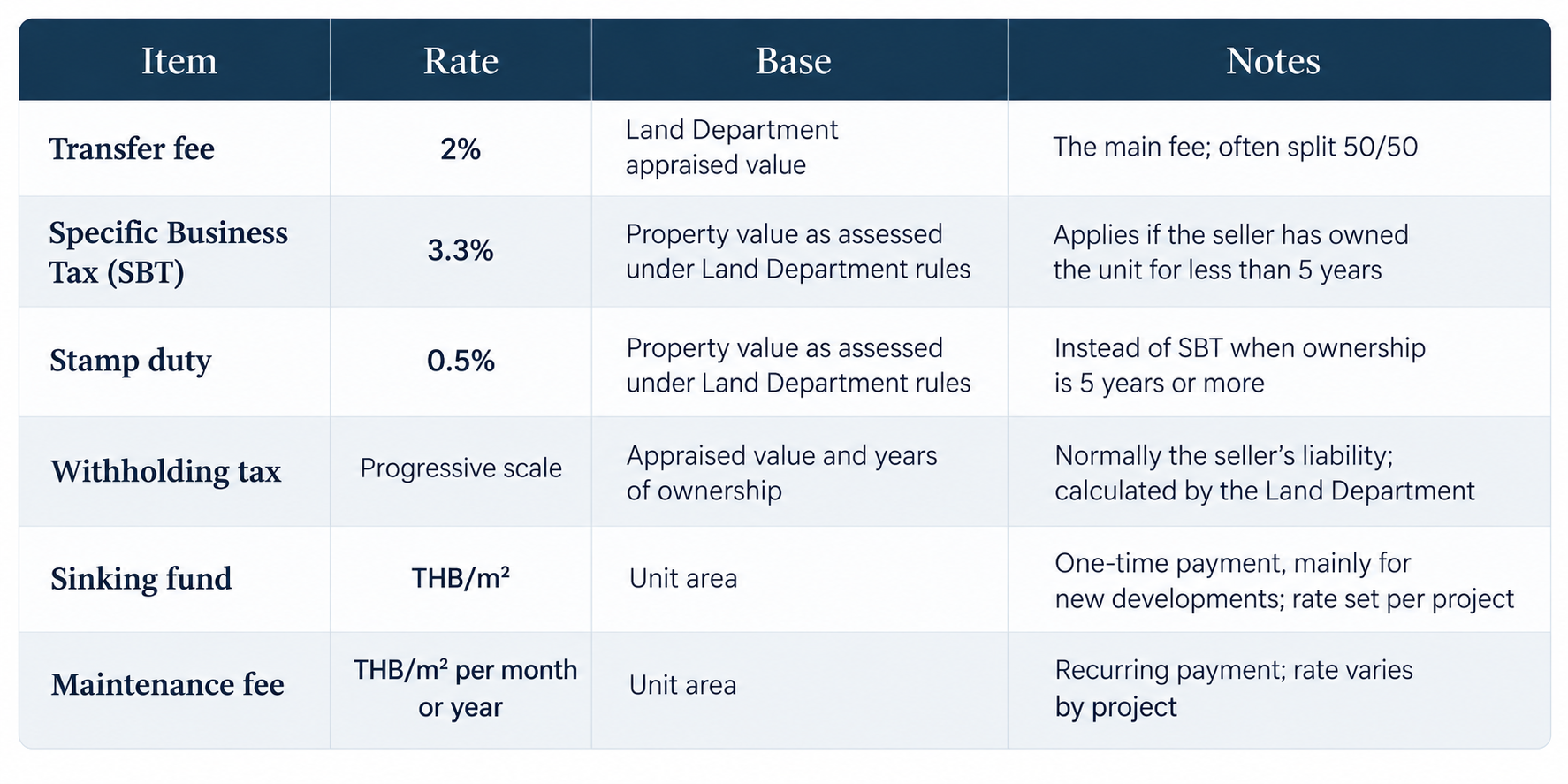
Example: on a 3.8M THB unit (the Jomtien median), the transfer fee is 76,000 THB if the appraised value matches the price. The appraised value can differ from the sale price, so confirm the exact fees before registration. Developers may add meter-connection and furniture charges — check the contract.
Buying from abroad: money, power of attorney, taxes
Moving the money
The requirement is simple to state: funds must arrive from outside Thailand, in foreign currency, in the buyer’s name, with the purpose stated as a condominium purchase. In practice the route depends on your bank and country of residence. Some buyers send directly from their home bank, others via an account in a third country. Sending in Thai baht, from someone else’s account, or without the purpose stated can mean no FET — and no registration. Confirm the route with your bank before signing and allow time for it to clear.
Conversion into baht happens in Thailand on arrival, so the final cost in your home currency depends on the exchange rate on the day the funds land.
Buying remotely under power of attorney
You do not need to be in Thailand. The deposit, contract and transfer are handled remotely, and a representative registers the transfer at the Land Department under a power of attorney — normally in the Land Department’s own format, certified in Thailand or through a Thai consulate; the exact procedure depends on your situation. We run these transactions regularly and send the document list and certification steps in advance.
Tax at home
Owning property or a bank account abroad may create reporting obligations in your country of residence, and rental income may be taxable in both countries. Speak to a tax adviser before the transaction, not after.
Visas
Buying a condo does not grant a visa. For long stays, buyers look at long-term options such as the DTV, the retirement Non-O and the LTR — check the current conditions when you apply.
Common mistakes
- Paying a deposit before checking the quota. The money is in — and the building’s foreign quota is full, leaving only leasehold or a company structure.
- Getting the transfer wrong. Baht instead of foreign currency, a third party’s account, no purpose stated — no FET. Fixing it is slow.
- Losing the FET and deal documents. Repatriating money after a sale becomes harder without them.
- Not agreeing who pays the fees. On a 3.8M THB unit the gap between “50/50” and “buyer pays all” is tens of thousands of baht.
- Skipping the debt check. Unpaid condo fees travel with the unit, and the Land Department will not register without a debt-free letter.
- Buying Thai quota because it is cheaper. You cannot resell it to a foreign freehold buyer, so your exit market is smaller.
How long it takes
- Resale: from reservation to registration usually 2–3 weeks when documents are ready and the funds have cleared; with an international transfer in the chain, plan for 30–45 days.
- Off-plan: contract and first instalment within a couple of weeks, then scheduled payments until completion; title registration after handover.
These are indicative; the least predictable step is the international transfer.
The bottom line
A foreigner buys a Thai condo outright when the building has foreign quota available and the money arrives from abroad with an FET. Three things decide the outcome: quota and title checks before the deposit, a correctly structured transfer, and a clear contract that says who pays what. The rest is process, and the agency handles it.
We will shortlist foreign-quota units for your budget, verify the building and run the transaction end to end, including remotely. Message us on WhatsApp or Telegram.


