
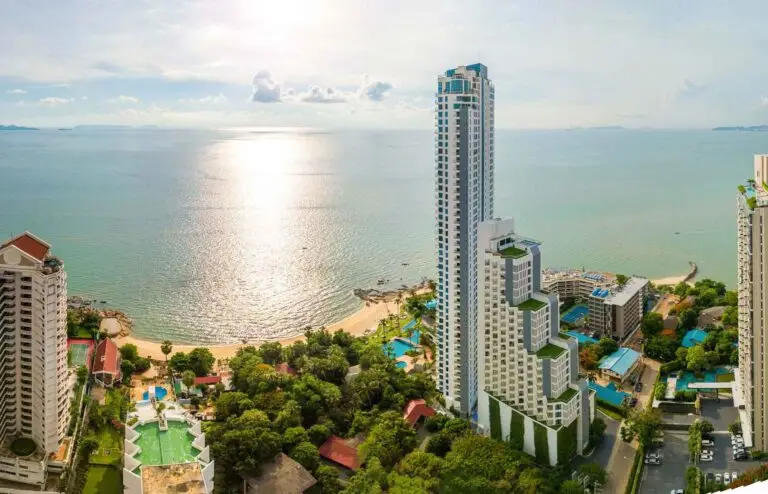
Strip a Pattaya condo down to what actually holds value and two things remain: the legal quality of the title and the view. Fit-out depreciates from the day you buy; furniture packages age quickly in salt air; but a protected, direct line of sight to the sea is finite in a city that keeps building, and the market prices it that way — at purchase, in rent and at exit. This guide is about buying that view well: what “sea view” really means in a listing, what it costs on our September 2026 listings, and how to verify that nothing will be built in front of it.
The view is the asset, not the unit
A view is the one feature no renovation budget can add, and the one feature a single construction crane can remove. Buying view inventory is therefore two separate jobs: judging the view itself, and verifying it will still be there in five years. Most buyers do the first at a viewing and skip the second. The second is where the money is.
Listing language, decoded
“Sea view” in Pattaya marketing covers everything from a full horizon panorama to a slice of blue visible from one corner of the balcony. The gradations matter financially.
Direct sea view
The living room and balcony face the coastline and water dominates the frame. This is the inventory that earns the full premium and resells first. Within the category, a high-floor horizon view outprices “sea over rooftops” from the sixth floor.
Side sea view
The sea sits at an angle — visible from the balcony edge or one bedroom, often in a gap between towers. An honest side view is a legitimate compromise, but it should be priced closer to a city view than to a direct one. When a seller prices a side view as a full sea view, that gap is your negotiation.
Marketing sea view
A sliver of water between two buildings, visible if you lean. Only a viewing exposes it: sit on the sofa, stand at the kitchen counter, and judge what is visible from the positions you actually live in.
What the view costs in Pattaya, on our listings
Our catalogue tags every apartment with its view, so the price gap can be measured rather than guessed. The medians below compare units listed with a sea view against units listed without one, as of September 2026. One caveat carries weight: sea-view listings are, on average, in newer, taller, better-located buildings, so the gap overstates the pure premium for the view. Like-for-like within one building, the difference is smaller — but it is never zero.
| Unit type, Pattaya | Median asking price, sea view | Median asking price, no sea view | Listings (sea / no sea) |
|---|---|---|---|
| Studio | 3,200,000 THB | 2,000,000 THB | 37 / 45 |
| One-bedroom | 5,495,000 THB | 2,795,000 THB | 80 / 102 |
| Two-bedroom | 9,700,000 THB | 5,000,000 THB | 60 / 53 |
| Price per m², all units | ≈ 110,900 THB | ≈ 63,500 THB | 178 / 204 |
By district the pattern holds: a Jomtien one-bedroom with a sea view lists at a median 5,490,000 THB against 2,400,000 THB without; on Pratumnak 5,450,000 against 2,850,000; in Na Jomtien 4,800,000 against 3,475,000. Wongamat is the exception that proves the rule — 4,900,000 against 4,500,000 for one-bedrooms — because almost everything there is close to the water and the “no view” stock is already premium. Note that Wongamat sea-view listings start well below the eight-figure prices the district is known for; the entry is not the problem, the choice of line is.
Rent moves with the view too, though on smaller samples: one-bedrooms listed for long-term rent with a sea view ask a median 18,500 THB a month against 14,000 THB without; studios 17,000 against 11,000. Set those against the price gap above and the conclusion is honest rather than glamorous: the view improves the rent and the exit more than it improves the yield ratio. You pay the premium for liquidity and resale, not for a higher percentage.
Floor height, building lines and view permanence
Front-line buildings face the beach or promenade directly. Thai coastal-zone building rules limit height in the strip closest to the shore, which is why a genuine front-line view rarely gets blocked — and why it carries the highest entry price. The exact restriction depends on the plot and the local plan, so have it confirmed for the specific building rather than assumed.
Second and third lines are where the geometry starts. Your windows need to clear the rooftops in front — and the calculation has to use permitted heights, not current ones. A three-storey guesthouse on a plot zoned for high-rise is not protection; it is a countdown. The day that plot sells to a developer, your “view over the roofs” becomes a view of a curtain wall.
Pratumnak Hill is the structural exception. Elevation gives buildings tens of metres of free height, so panoramas open up even from projects set back from the water, and the hill has little vacant land left for new towers. On protected view per baht it is the most rational location in the city — our listings there show a sea/no-sea price gap comparable to Jomtien’s, at a lower district median (3.0 million against 3.8 million THB).
Will a tower rise in front? How to verify
This is the single most expensive due-diligence step buyers skip. The check is concrete:
- Walk the plots. Identify every parcel between your building and the water. Vacant land, surface parking and ageing low-rise stock are all candidate construction sites — the larger and flatter the plot, the higher the risk.
- Pull the zoning. Pattaya’s city plan defines what height and density each parcel allows. A lawyer or agency requests this routinely; it is not exotic paperwork.
- Ask about EIA approvals. Larger condominium projects in Thailand must pass an Environmental Impact Assessment before construction, and an approved EIA is the earliest reliable sign that a tower is coming. Ask your lawyer to check the plots in front.
- Ask about the launch pipeline. Developers announce launches well in advance, and agencies working the new-build market usually hear about them before the press releases.
Off-plan buyers face a second version of the same trap: renders shot from the penthouse stack. Request the floor plate, locate your exact unit, and ask to see the real view from an equivalent floor of a completed phase or a neighbouring tower of similar height. The difference between a 30th-floor render and an 8th-floor reality can be the entire premium you are paying.
Where view inventory holds value
Wongamat
Northern Pattaya’s quiet, upmarket strip. Front-line towers face open water with a beach, not somebody’s plot, between them and the sea; the tenant pool is long-stay and the buyer pool at resale is international. Browse the district at Wongamat.
Pratumnak Hill
The compact premium hill between the centre and Jomtien. Elevation creates views beyond the front line and the scarcity of buildable land protects them.
Jomtien beachfront
The deepest pool of view inventory in the city and its most liquid rental market. The front line along the promenade is positionally secure; second-line Jomtien is where caution pays, because this is the district still adding towers every year.
Current view listings across all three areas are collected on our sea view condos in Pattaya page, and the district-level medians behind the table above are updated on the Pattaya price index.
What to test at a viewing
- judge the view from living positions — sofa, kitchen, bed — not from the balcony rail;
- photograph the panorama yourself and mark every plot in frame where construction is theoretically possible;
- check orientation: west-facing means sunsets but also afternoon heat — inspect the air conditioning and glazing;
- listen: beach-road traffic and beach-club music reach mid floors;
- inspect the facade and balcony railings for salt corrosion, and ask the juristic person about the maintenance schedule;
- return at a different time of day — a morning sea and the evening glow of a construction site behind the corner are different purchases.
Then ask the seller directly what is planned on the land in front, and verify the answer independently. “Nothing will ever be built there” without documents is an instruction to dig deeper.
Sea view as your exit strategy
Most buyers underwrite the purchase on rent and treat resale as an afterthought. View inventory inverts that. When a building goes to market — and every building eventually has several units for sale at once — the direct-view stack sells first and holds its asking price longest, because international buyers shortlist by view before anything else.
Two factors multiply the effect at exit. First, foreign-quota status: a protected view plus a unit registrable freehold in a foreigner’s name is the combination overseas buyers compete for, which is why foreign quota condos with direct views are persistently scarce. Second, irreplaceability — if zoning and built-out plots mean no new tower can replicate your line of sight, your unit competes only with its own building’s stack, not with every new launch in the district.
Bottom line
A sea view condo in Pattaya is two purchases in one — the panorama and its permanence. The first you judge at a viewing: direct versus side, height above surrounding rooftops, the real frame from where you will actually sit. The second you judge on paper: the plots in front, their zoning, EIA approvals and the developer pipeline. On our listings the view roughly doubles the median price of a one-bedroom and lifts long-term rent by about a third, so the premium is real and so is the risk of losing it. Pay it where the view is defensible, treat the verification work as part of the price, and compare the district medians in our 2026 price guide before you fall for a balcony.


